

Berlin is buzzing: Satellite technologies from Berlin
Berlin, 29 April 2024 – The space industry in Berlin is booming. So much so that the capital region has developed into a hotspot for space technologies in recent years – not only at the national level, but also in a European comparison. Berlin companies, research institutions and start-ups are placing a particular focus on the research, development and application of satellite technologies. A large subject area that Berlin Partner is also actively promoting within the framework of projects and events as a well-networked cooperation partner.
Today, satellites play a major role in various areas of everyday life. They provide important data that makes navigation safer and communication faster, for example. Using satellite images and data, researchers can document and analyse environmental changes and thereby gain important insights, for example in matters of climate protection. Access to information from space and the database generated are therefore already an important basis for the development of innovations, the improvement of existing systems and processes and for decisions at a wide variety of levels.
Berlin is increasingly gaining influence and public awareness as a promising location for space technologies. The companies based in the capital region are extremely well networked and incredibly diverse. This makes it a highly innovative and forward-looking sector of the Berlin economy – the so-called Space Business. The international “Conference on Small Satellites for Earth System Observation”, which was held for the first time in May 2023 and was organised by the German Aerospace Centre, TU Berlin and the International Academy of Astronautics in cooperation with Berlin Partner, showed just how relevant this is. 270 participants from 30 nations debated current topics, innovations and impulses of modern space technology as part of the four-day specialist conference.
In Berlin though, things are not only discussed, they are also implemented: The Raccoon project, which is funded by the Federal Ministry of Economics and Technology, is being carried out by the Technische Universität Berlin, among others, and supported by Berlin Partner through the ICT and Transport, Mobility and Logistics clusters, and aims to generate benefits for a wide range of technical areas. The project involves the development of a technique based on post-quantum technology that enables the global transmission of security keys for use on satellites. The goal is to use this technology to protect system-critical infrastructure.
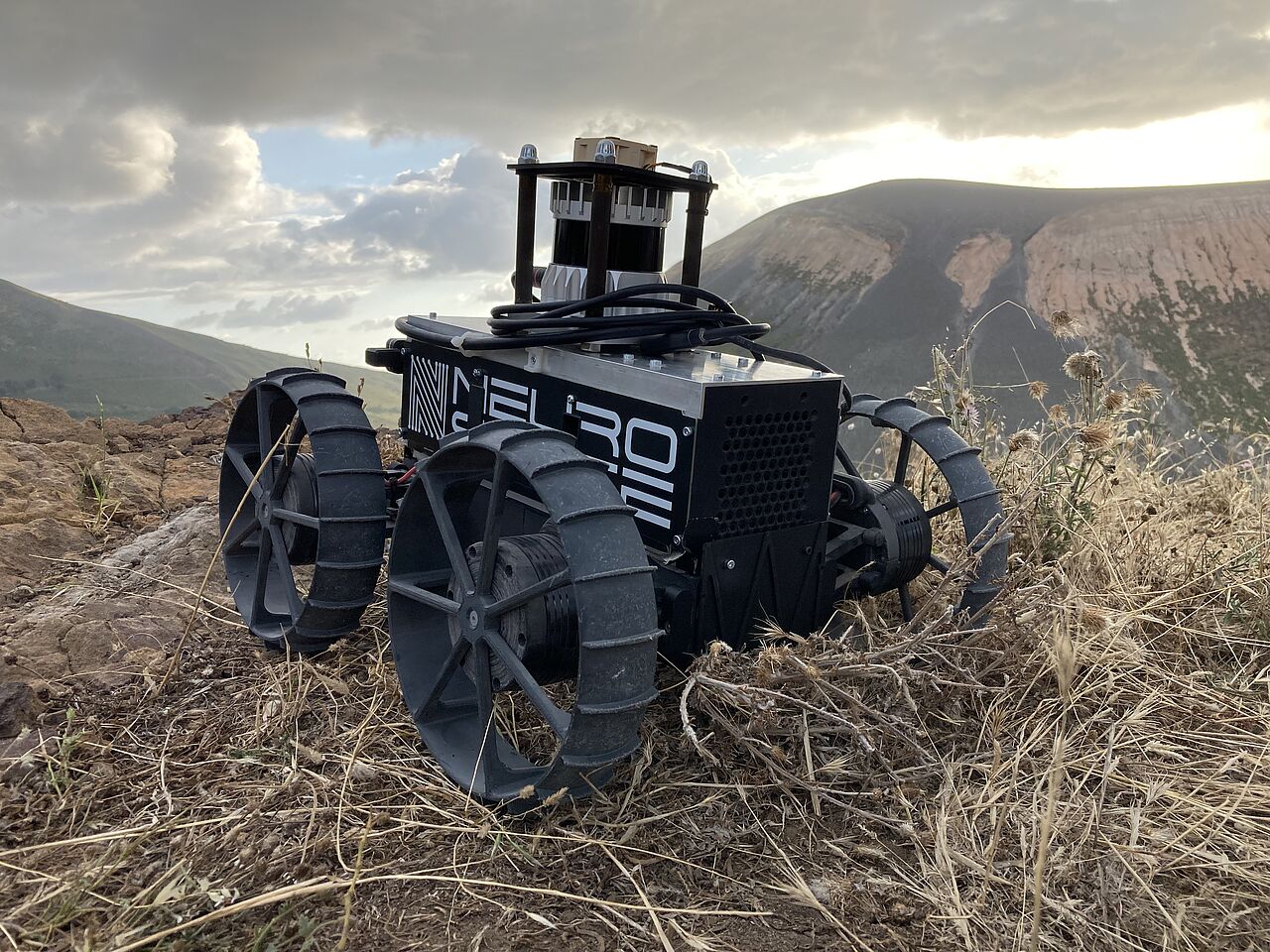
The diversity of Berlin’s Space Business is also reflected in other forward-looking developments. The startup NEUROSPACE is working on a lunar rover that will one day explore the moon. Irene Selvanathan, founder and CEO, explains:“As hardware and software developers for the aerospace industry, we wanted to work with a technology that was a little more sustainable than the previous ones. We ultimately decided on rovers for the moon because we were originally looking for an open and modular robot platform and discovered that no such platforms exist for either earth applications or space travel. In fact, there are many robots and robotic solutions that are highly specialised, but not a single qualified platform that is open and based on open source and therefore offers users the opportunity to use the robots as an experimental platform to try out their own ideas. Our biggest goal is to send the first German rover to the moon in the next two to three years – developed and built in Berlin.”
In addition, students will be able to complete the international Master's programme in Space Medicine at Charité Berlin from the winter semester of 2024, while the Technische Universität Berlin, in cooperation with the Laser Zentrum Hannover and as part of the Moonrise project, wants to bring 3D printing to the moon and use laser radiation to melt moon dust in order to subsequently create infrastructure such as landing sites on the celestial body. The analysis of satellite data with artificial intelligence by the Berlin-based company LiveEO or the “high performance small satellite platforms” of the NewSpace start-up Reflex Aerospace from Berlin and Munich also suggest one thing in particular: The Spree metropolis is aiming high. NEUROSPACE founder Irene Selvanathan also provides good arguments for Berlin as a location: "There is a large start-up scene here and also many start-ups in the NewSpace sector. The proximity to universities, including the TU Berlin, but also to many scientific institutions is also a decisive factor.”