
Berlin goes India
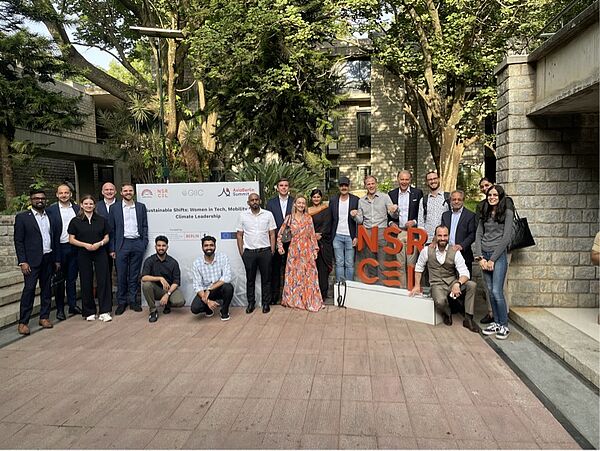
Berlin, July 10, 2025 – With a population of 1.4 billion and a gross domestic product of approximately $3.9 trillion, India is not only the world’s most populous country but also an increasingly important economic partner for Berlin. From July 8 to 11, 2025, Berlin’s Senator for Economic Affairs, Energy and Public Enterprises , Franziska Giffey, led a 25-member delegation to the dynamic tech hub of Bengaluru and the capital region of New Delhi to deepen bilateral economic relations. The delegation included Stefan Franzke, CEO of Berlin Partner; Jeannine Koch, CEO of media association medianet berlinbrandenburg; and Birol Becer, board member of the Berlin Chamber of Commerce and Industry, along with additional representatives from Berlin-based companies, associations, and startups.
India is one of the key focus regions in Berlin’s new internationalization strategy, introduced to the Berlin Senate by Senator Giffey in early July. The goal: expand existing business ties and foster new collaborations.
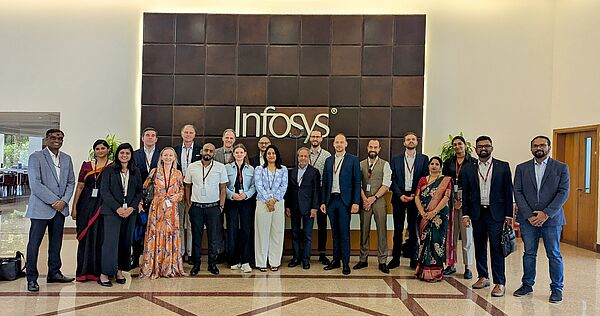
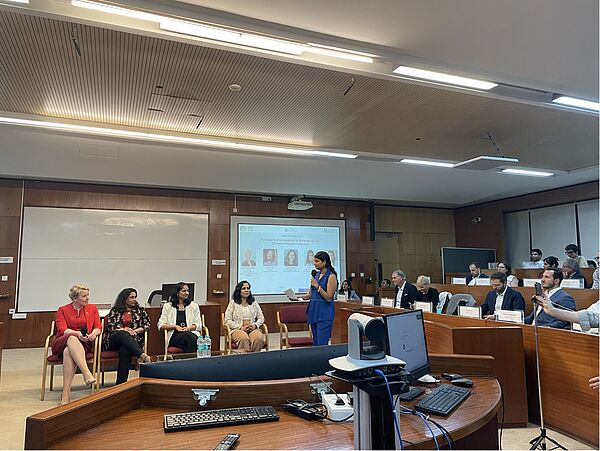
The trip began in Bengaluru, India’s fourth-largest city and a major center for IT, aerospace, biotech, electronics, and e-mobility. The group visited various companies, including Infosys, one of the country’s leading tech firms, and the R.V. College of Engineering, where a Berlin Pitch event brought together students, faculty, and business leaders for networking and knowledge exchange. A further highlight of the visit was the signing of a cooperation agreement between Berlin and the state of Karnataka, of which Bengaluru is the capital. Discussions were also held about establishing an official Berlin representative office in India.
On July 10, the delegation traveled to India’s capital, New Delhi, a megacity of over 31 million and one of India’s top economic hubs alongside Mumbai and Bengaluru. There, meetings were held with key institutions, including the German Embassy and the Ministry of Electronics and IT. The delegation also visited Maruti Suzuki Innovation, the Indian Institute of Technology Delhi (IITD), and the liaison office of the Freie Universität Berlin in Neu Delhi. An exclusive networking dinner with leaders from business and government offered Berlin’s representatives another opportunity to strengthen ties and explore future cooperation.
The city of Berlin and the state of Karnataka have maintained close business relations for years. In Bengaluru alone, home to more than 25,000 IT companies and global firms like SAP, Mercedes-Benz, and Continental the economic potential is vast. The delegation returned to Berlin with valuable insights, new partnerships, and a deeper appreciation for India’s innovation landscape.
© Berlin Partner