

A real high-flyer
Berlin, 6. May 2025 – All good things come from above? Certainly not always, but in this case definitely: As part of the cooperation project “City-Rural-Drone”, the Berlin-based company Luftlabor GbR tested the use of drones for local supply in two districts of the small town of Wusterhausen / Dosse in Brandenburg.
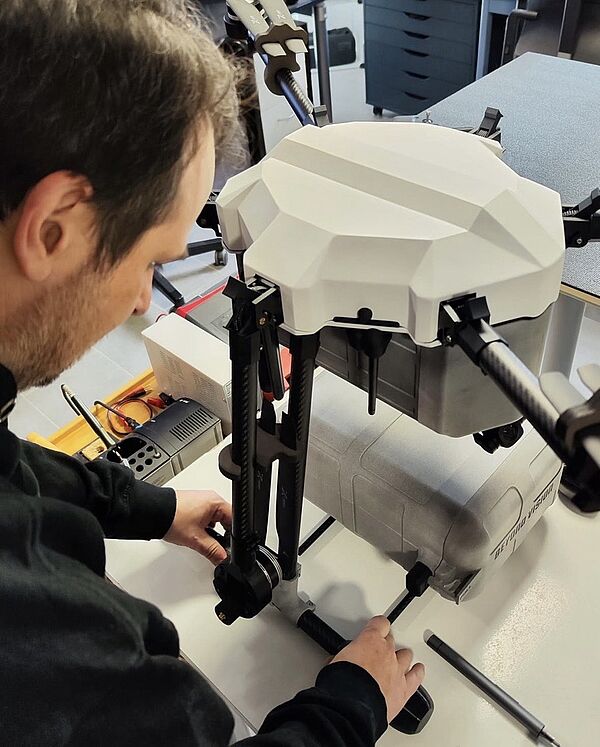
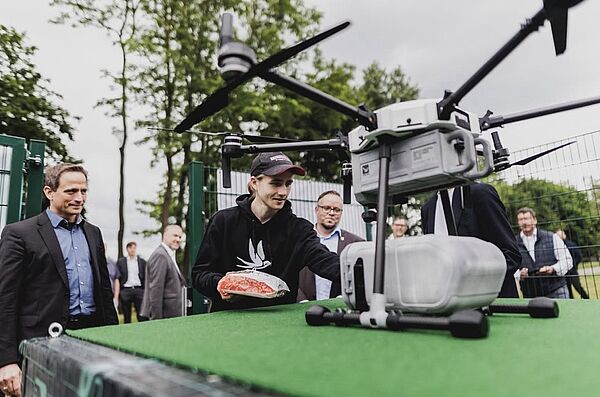
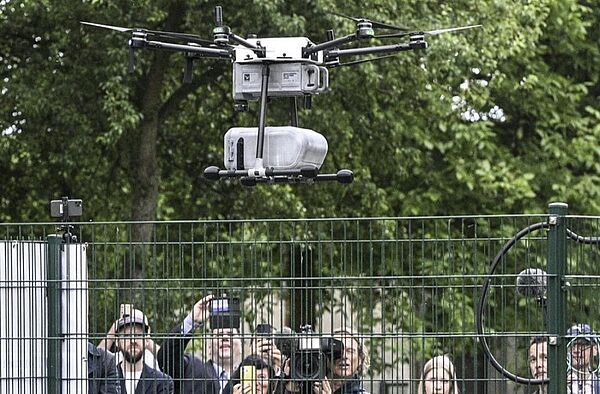
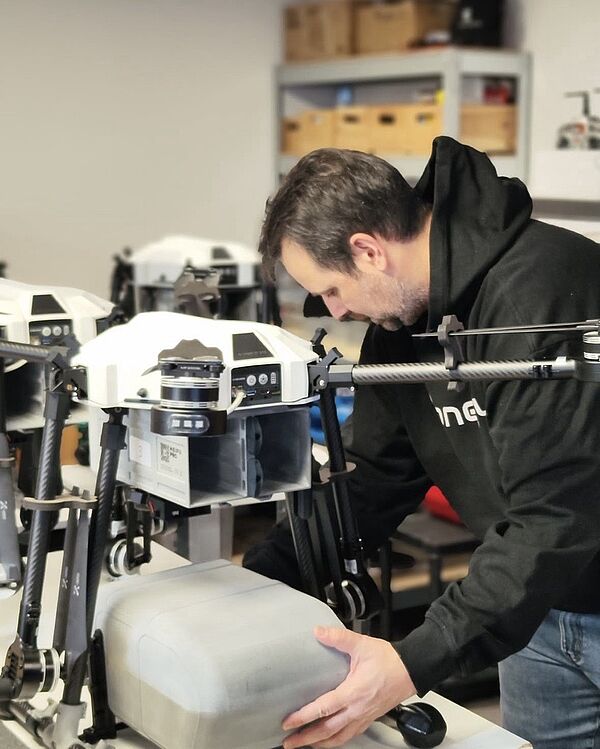
Although more and more people are moving to the countryside, the provision of supplies in rural areas is facing challenges throughout Germany. Particularly in sparsely populated areas, the following is noticeable: The distances to the bakery, the doctor or to the shops are (too) long, and more and more restaurants and many retailers have to close. Everyday errands quickly become a logistical hurdle for local people who do not own a car, are too young, too old or have physical limitations. This is a growing problem that the project and research service provider Luftlabor is tackling with a pioneering technology. The implementation of the project was a tall order. Together with partners, including Berlin Partner, the company developed a flexible delivery drone and tested its use where people in rural areas need support most: in their everyday lives. The “Marktschwalbe” delivers orders from the central weekly market, local shops or restaurants to pick-up points and thus directly to customers. It has a range of up to twelve kilometres and a load capacity of around four kilogrammes. Anyone who wants to use it can place an order via the online marketplace or by phone – and will receive barrier-free delivery.
The test operation of the model project carried out in Brandenburg was officially opened on 31 May 2024. An intensive development phase, in which Berlin Partner was also involved, preceded the successful flight of this innovation, which can be used across national borders. The Berlin business promoter supported Luftlabor by networking with other stakeholders from industry and the relevant authorities, contributed to increasing the visibility of the cooperation project at trade fairs and political events and, together with Luftlabor, organised a workshop on the use of drones in Berlin.
But not only in the air, the drone also creates excitement on the ground: Almost three-quarters of Germans support the use of drones for local supply in rural areas. That is why the Luftlabor team is pursuing not just one, but several goals. The aim is both to ease the burden on residents of rural areas in their everyday lives and to support local retailers. For this reason, the operating concept was developed not only for, but also with the local population – and successfully so. Managing Director Tobias Biehle reports: “The commercial, logistical, and technical aspects now mesh well together, allowing us to ensure an increasingly reliable and attractive service.”
The “Marktschwalbe” is therefore both an innovation and an opportunity. An innovation that impressively solves logistics problems from a technical perspective and an opportunity for economic growth. Based on the practical experience gained, Luftlabor now wants to develop a business model that can be transferred to other municipalities. A look at the sky will definitely be worthwhile in the future.

The managing directors of Luftlabor GbR: Tobias Biehle (l.) & Dr. Robin Kellermann
Copyright: Björn Haase-Wendt
Copyright: Instagram / @stadt_land_drohne_wusterhausen
Copyright: Jens Kalaene (dpa), BMEL / Photothek, Simon Wöhr
Copyright: Jens Kalaene (dpa), BMEL / Photothek, Simon Wöhr
Copyright: Instagram / @stadt_land_drohne_wusterhausen