How circular are Berlin companies?
Berlin, 8. April 2025 – For more than a year now, Berlin Partner has been part of the CEC (Coordination Centre for Circular Economy, Energy Efficiency and Climate Protection in Companies) – gaining valuable insights into Berlin companies of all sizes and sectors through intensive discussions and practical workshops. The overall objective of the CEC is to support companies in identifying and implementing measures related to energy efficiency, resource conservation and climate protection. In line with this, an exciting trend is emerging in the capital region: More and more companies, from established businesses to young startups, are getting involved in circular economy. The focus is on conserving resources through closed cycles. That means: Materials are reused, waste reduced and recycling promoted. As part of the Masterplan Industrial City Berlin 2022 – 2026, circular economy is also a highly relevant topic at state policy level. For this reason, the CEC and the Berlin Partner team involved are actively supporting Berlin companies. From initial orientation to in-depth workshops and joint production tours: The Circular Economy experts accompany the companies on their path to becoming a sustainable and future-proof company.
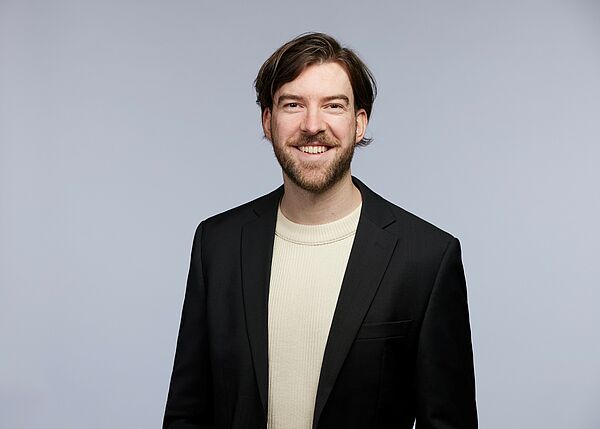
Robin Bruck, Manager Climate Protection and Circular Economy at Berlin Partner, reports on experiences from the past year and goals for the future.
1. What makes the topic of Circular Economy (CE) so exciting?
I am inspired by the need for creative solutions. It’s great when companies install PV systems on their roofs or increase the efficiency of their buildings. However, CE really gets down to business: It affects the business model, the way in which companies earn money. Whether using bio-based materials, product-as-a-service or take-back systems for your own products - the approaches vary from industry to industry, but every company can take the path that suits them best. From a political perspective, the direction is clear, as CE promises solutions to a variety of strategic issues, such as raw material availability, geopolitical dependence, and regional value chains.
2. Is your offer accepted by Berlin companies?
Yes and no. Most of the companies we have reached so far have already discovered sustainability as a unique selling point in their market, want to further enhance their profile in this area and have already taken advantage of other offers from our sustainability service. We also have a lot to do with startups. It is easier to change a product or business model that is either not yet on the market or has only recently been launched. As far as the broad masses are concerned, we are still ahead of the curve with this topic, as the economic incentive and therefore the urgency is not yet great enough. New materials and products that cannot be repaired or recycled are still too cheap, as negative externalities from production, e.g. GHG emissions, or end-of-life, such as processing costs or marine waste, are not yet adequately priced in.
3. What are your hopes for the second year of the project?
We would like to have more discussions with manufacturing SMEs from the masses. The lack of urgency outlined above can quickly change in view of the strained relationship with China or new laws. It’s not about overturning a long-established business model overnight. We want to enter into dialogue on an equal footing and provide impetus to prepare and experiment with the first circular products and services.